
The Second Edition of
Roger Federer Jumpulse Tennis
is now available. Click Here.

Custom Search

The Jumpulse Stroke

Two-Handed Backhand with Lift and Jumpulse, No Close

Note: The racket moves faster than the ball after the prolonged contact.

With Double-Hitting


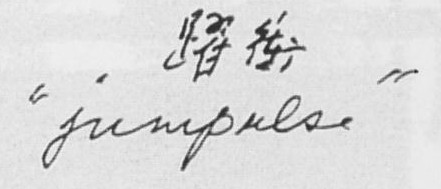
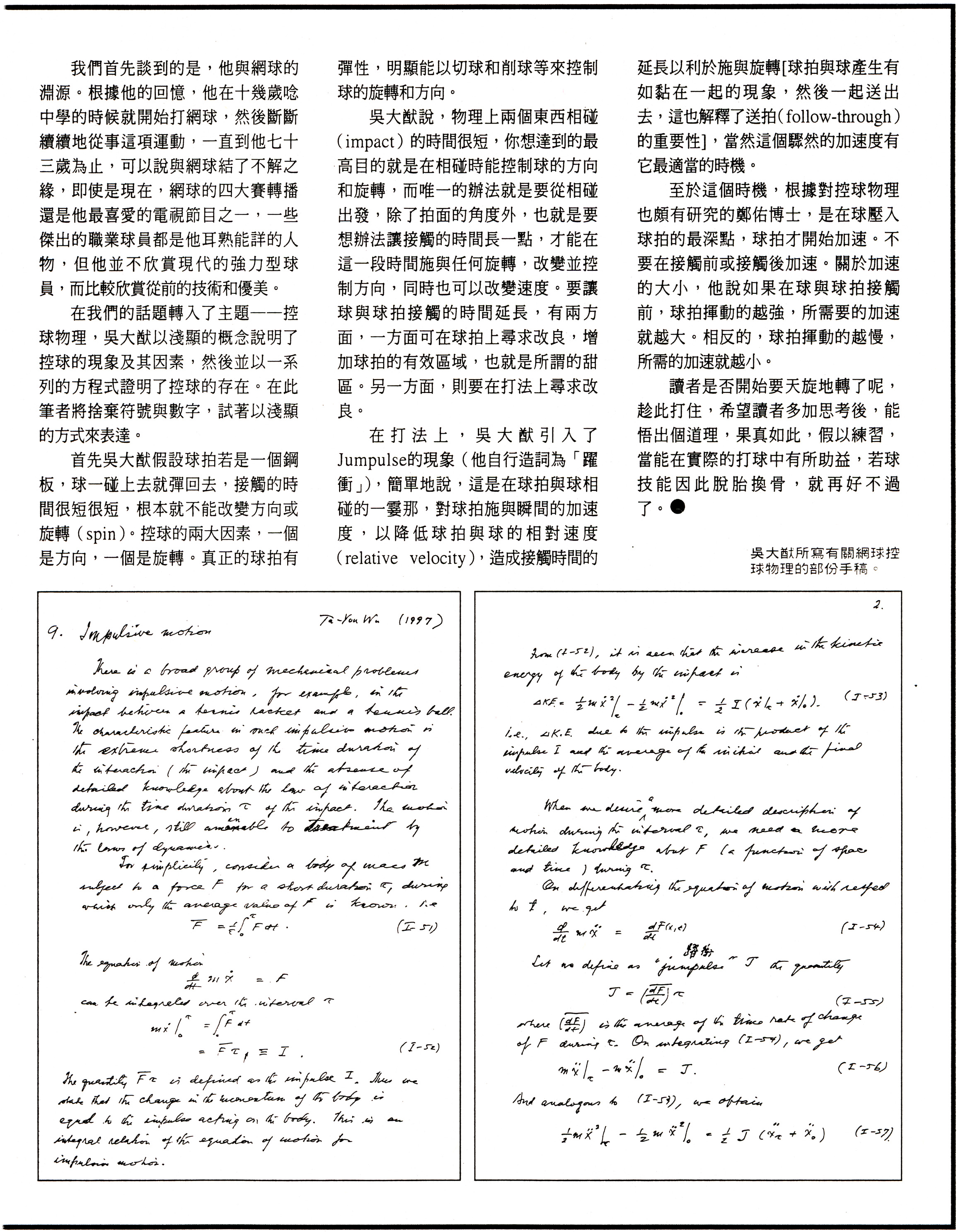
in Dr. Ta-You Wu's own handwriting...


The Jumpulse Stroke
(Jumpulse Tennis and Jumpulse Table Tennis)


Ball Control Graph

Jumpulse Stroke = Natural Movement of Touch + Scientific Analysis of Historically Best Stroke

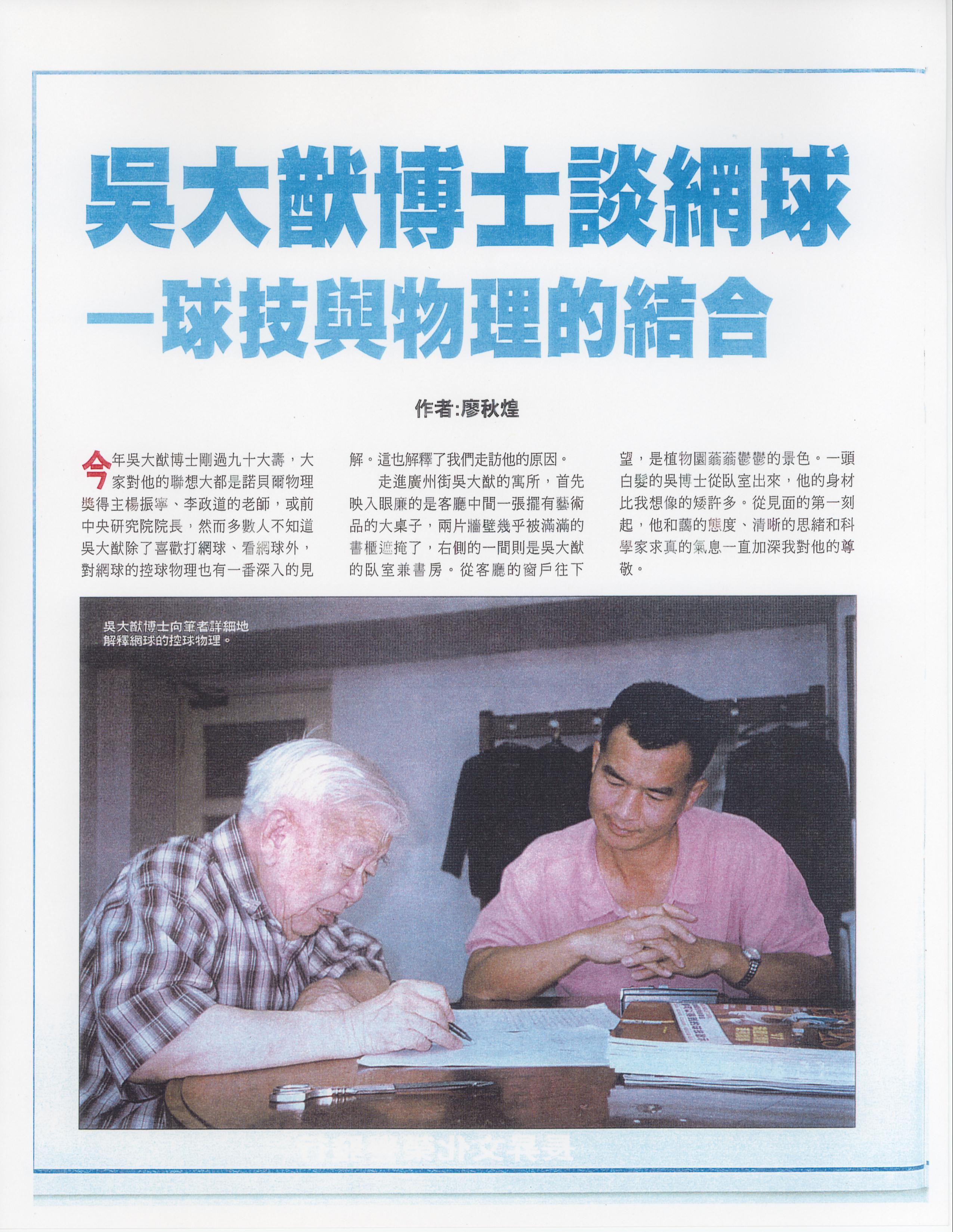
The goal of Jumpulse Tennis and Jumpulse Table Tennis is to analyze, teach, and learn the Jumpulse Stroke, as demonstrated by Roger Federer's forehand in tennis and by China's Chuang Tse-Tung, who dominated table tennis in the 1960s and Taiwan's Chen Yin-Lieh, who invented the loop, in table tennis. Jumpulse Tennis combines the theory of Ball Control of Dr. Hugh Ching and the formal physics concept of jumpulse of his teacher Dr. Ta-You Wu, Father of Chinese Physics, to analyze the prolonged contact of Federer's tennis forehand stroke below.

The Jumpulse Stroke could be the most scientifically correct tennis or table tennis stroke for beginners to learn because it has helped two of the most popular champions in history to dominate sports in their times. The first is China's Chuang Tse-Tung in table tennis. He completely overwhelmed his competitors with his almost never-miss forehand and backhand strokes, which were characterized by extraordinarily long prolonged contact between the ball and the racket. The second player is Roger Federer in tennis. He is currently the number one player in the world. His forehand stroke has applied the advantage of prolonged contact to the most efficient use in the Jumpulse Stroke. Historically, up to now, the Jumpulse Stroke of Roger Federer should be considered one of the most scientifically correct and the most kinetically efficient human movements in sports.

Jumpulse is a sudden change of force. When applied with precise timing, namely, at the moment of impact, jumpulse allows prolonged contact between the ball and the racket. When the ball is in contact with the racket, a player of tennis, table tennis, racket ball, golf, baseball, etc. can hit it in the desired direction, add power or spin to the ball, etc. as demonstrated by Roger Federer. Jumpulse is also the solution of touch, a solution, which has escaped Isaac Newton and all the scientists since Newton for the past three hundred years. The Jumpulse Stroke conceptually is simply an extension of touch, from the hand to the racket, the club, or the bat. God or nature has given human beings the ability of touch, while no robot today can touch, and post-science is extending the human natural, but very subtle, ability of touch to the sport motion of the Jumpulse Stroke, which needs special training.

The time scale of the following frames is not known exactly, but it is not as important as the distance of contact. There seem to be repeated frames when the ball is moving at its lowest velocity, indicating nothing more than that the time step of advancement of the camera is smaller than the time step of the original frame-by-frame recording, where both of the time step scales are uncertain. The frame-by-frame display shows that the ball is hit near the top of the racket surface, which slides up vertically almost two inches, and that the ball finally leaves the racket near the center of the racket surface with a horizontal prolonged contact of over two inches.

Most importantly, upon close inspection, the ball has been LIFTED about two inches! The difference of two inches from the moment of contact to the moment of exit of the ball gives the stroke a much higher probability of entering the opponent's court. Additionally, the topspin resulted from the upward racket motion further increases the probability of a good shot and allows the racket to grab the ball with a non-slipping condition, which is one of the requirements for Never-Miss Tennis or Table Tennis. The remaining prolonged contact is used to rotate the racket and to guide the ball to the direction, which the player wants the ball to go or can impart additional spin or power.

Upon very careful inspection of the frame-by-frame display, one sees a phenomenon that does not contradict mathematical analysis. The upward lift is done before and after the maximum indentation of the sting surface, and that the jumpulse is applied on or after the moment of the maximum indentation, at or around time = 45 frame of the frame-by-frame display. This is an extremely efficient design of a Jumpulse Stroke because prolonged contact requires that the sudden increase of acceleration be applied after, not before, the maximum indentation and be applied in the horizontal direction, which is a shift from the mostly upward vertical direction before the application of the jumpulse.

The important lift of the ball is initiated before the maximum indentation, a period of contact when any forward acceleration will have only little effect on the contact time. To be sure, an additional benefit of the upward lift is that the collision between a ball and a moving surface, namely, the racket softens the impact, resulting in an smaller relative "effective" impact velocity, which is directly proportional to the magnitude of the jumpulse required for prolonged contact. For tennis, because of the strong impact of the collision of the ball and the racket, the racket surface is generally just one or two degrees from the perpendicular direction of the impacting ball. For table tennis, often the angle of impact can be very large. The trajectory of the table tennis racket surface can even be parallel to the incoming trajectory of the ball, especially, for loop or strong backspin. The sliding stop in table tennis can help to generate a very long prolonged contact, increasing the distance of contact from inches to a maximum of a foot, as demonstrated by Chen Yin-Lieh, the inventor of the loop in table tennis.

Another important physics law of nature, without which human being might not be able to touch and Roger Federer, to achieve his extraordinary feat in prolonged contact, is the Ching's law of touch, which states that acceleration, unlike position or velocity, can change instantaneously. To increase the acceleration instantaneously, or to apply a jumpulse, Roger Federer, as shown in the frame-by-frame display, has to wind up his whole body, from his fingers to his shoes covering the entire kinetic chain, like a spring and to release the spring force instantaneously at the precise moment, namely, at or after the moment of maximum indentation.

Thus, from the frame-by-frame pictures we see that Prof. Roger Federer has designed a Jumpulse Tennis Stroke, which puts the advantage of prolonged contact to most efficient use. The stroke ends with a horizontal and a rotational follow-through, respectively, resulting from trying to maximize the acceleration and the pronation (rotation of the racket) at the moment of impact. Post-Science Institute calls this stroke the Jumpulse Stroke. Dr. Ta-You Wu's jumpulse (http://jumpulse.com) is the solution of touch or collision without bounce. Jumpulse is a sudden change of force, as Newton's impulse is a sudden change of momentum. Jumpulse can be demonstrated with prolonged contact in table tennis and tennis. Prolonged contact is the secret of consistency in almost ALL sports.

One puzzling point on the precise timing in applying jumpulse has been the center of debate among sports scientists. The human response time is around 50 milliseconds, but the interaction time between the ball and the racket is only about 5 milliseconds. Also, a fast moving tennis ball becomes a blur when it is within five feet of the player. From the coaching experience of our jumpulse coaches in the past few years, it has not been difficult for people to achieve the precise timing required for prolonged contact. It can be speculated that one actually "seeing" the fast moving ball with one's mind rather than one's eyes. In fact, one feels the movement of the ball with all one's senses, including, in particular, the eyes, the ears, and the mind. The initial condition of the fast moving ball is set in one's mind before the ball is within five feet of the contact point. The hitting process is set in "auto-pilot" in one's mind when one can no longer clearly see the ball with one's mind. The precise timing is achieved through the mental image of the interaction between the ball and the racket.

Jumpulse Table Tennis can also be used for Early Brain Calibration (EBC) of the brain hardware of, say, a baby's vision for super-fast timing resolution in its first six months and the muscle for acceleration in its first two years to develop future champions. Initially, a vacuum exists in a child's mind for a way to hit a ball with a racket. Once this vacuum is filled, it would be difficult to change it's content, which is an extremely intricate pattern of mental images of how to hit a ball. Our Certified Tennis and Table Tennis Coaches mainly in Silicon Valley, California, USA will teach the parents and their children the timeless physics principles of sports. And, in turn, the parents will be the long-term coach of their children.

As a final note, it is important to point out the difference between accelerating through the ball and applying jumpulse at the precise moment. Post-Science Institute has done a preliminary calculation on the effect of acceleration on ball control or prolonged contact. Roughly, a player needs to accelerate at about 90 G (gravitational force), which is equivalent to 75 lb., to keep double-hitting a ball within one inch of the surface of the racket for a relative impact velocity of 15 mph. A Jumpulse Stroke degenerates into an acceleration stroke when the timing is off. Therefore, Jumpulse Stroke includes the benefit of the acceleration stroke. Most professional tennis and table tennis players use acceleration stroke; historically, champions dominate sports, such as golf (Jack Nicklus), baseball (Ted William), tennis, and table tennis, with the Jumpulse Stroke.

The public introduction of the Jumpulse Stroke will raise the sports skill of all sports participants to a new level by extending the ability of touch from the hand to the racket. Jumpulse stoke should become a necessary skill for all sports participants, for it is the secret of consistency in sports. In the near future, all sports champions will be jumpulse players.

The solution of touch based on jumpulse has eluded Isaac Newton and all the scientists since Newton for the past three hundred years. The physics of jumpulse has also raised human knowledge to a new level, having extended the average five-variables problems in science to a twenty-five-variable problem of touch in post-science. Although the very subtle physics of prolonged contact of the Jumpulse Stroke is, thus far, only understandable to Post-Science Institute, its practical application is clearly demonstrated by Roger Federer and our jumpulse studnets. Jumpulse, through winning in sports, will demonstrate the power of knowledge.
[A Note On Federer's On-Handed Backhand: Federer's complete domination of tennis is tainted by his one-handed backhand, which is accurate, but not powerful enough to be an attack stroke. His one-handed backhand remains and will always be his weakness. Jumpulse Tennis needs two-handed backhand to generate enough power and enough jumpulse for the Jumpulse Stroke. Jumpulse Tennis encourages, and modern tennis requires, the development of both the right and the left hands or one-handed and-two handed strokes, which are to be used under different situations. Federer might try to train his unused left arm for a Two-Handed Backhand Jumpulse Stroke, which, if successfully developed, can give him a Full Jumpulse Tennis Style. Monica Seles has Jumpulse Strokes on both forehand and backhand, but with far less noticeable prolonged contact than that of Federer's forehand.]

Click here for the enlarged version of the frame-by-frame display

Click here for the Price Structure for the Jumpulse Table Tennis Lessons

Roger Federer's Ball Control Jumpulse Forehand Stroke
In Slow Motion (Frame By Frame)

Start at Time = 0. The time scale is in the order of one millisecond per time unit.
00 10 20 30 40 41 42 43 44 45 46 47 48 49 50 51 52 53 54 55 56


Knowledge Home Pages:
[Knowledge] [Post-Science] [Complete Automation] [Universal Permanent Numbers]
[Infinite Spreadsheet] [Infinite Spreadsheet(Real Estate)] [Infinite Spreadsheet(Stock)] [Infinite Spreadsheet(TimeVarying)]
[Knowledge Book] [Universal Permanent Software] [Universal Computer Source Code (UNCOSOCO)] [UNCOSOCO]
[Jumpulse] [Jumpulse Tennis] [Jumpulse Table Tennis] [Jumpulse Golf] [Ball Control Tennis] [Jumpulse Forum]
[Double-Hit] [Ta-You Wu] [T. L. Kunii] [Hugh Ching]